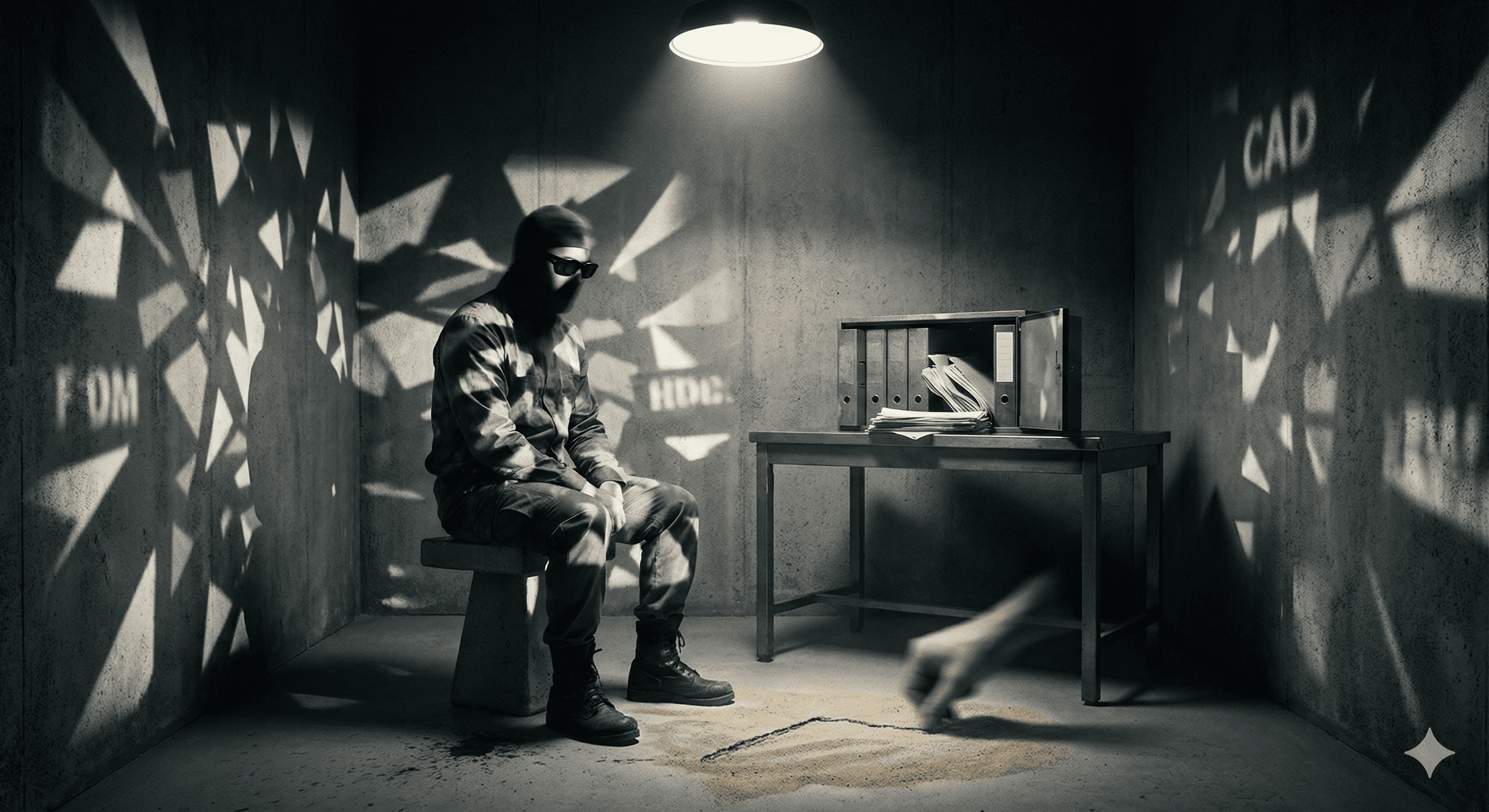
We all have a voice inside us that runs the show. For many of us, especially those raised in the "limitations" of 1970s Britain or similar environments of "social poverty," that voice sounds like a Foreman. He is the echo of the "box over the head"—the survival mechanism we built to endure the "lightning crack of the slap" and the "phantom fingers" of discipline.
But there is another voice waiting to be heard. A voice that doesn't demand, but guides. This is the Internal Teacher.
If you have ever felt the "internal 'what am I' stabbing you," or felt like a "flea in a petri dish" subject to the whims of the world, this post is for you. It is about how to fire the Foreman and hire the Teacher.
The Legacy of the "Invisible Chicken"
Growing up, many of us learned to "carry restlessness quietly." We developed an "Invisible Chicken" syndrome—a nervous system constantly flinching, waiting for the "vernal slaps" of a world that didn't understand us. In this environment, daydreaming wasn't seen as a gift; it was an "overindulgence," a dangerous "tightrope to cross."
The Foreman is the internal manager of this fear. He is the one who tells you that your inner sanctuary is just a "fantasy" or a "horror show" to the outside world. He keeps you on "invisible tracks," convinced that you are "useless," a "freak," or "not good enough."
But here is the truth I have found: The Foreman is a liar. He is merely a symptom of an unanchored frequency—a mind lost in what spiritual texts call the "projection of material".
Identifying the Grinding Voice
How do you know when the Foreman is in charge? You feel it. It manifests as "turmoil," "quiet sorrow," and the grinding noise of anxiety. The Foreman obsesses over the cracks in the pavement. He focuses on the "structures of power" and the "grey masses" that make you feel small.
The Internal Teacher, however, operates differently. As described in The Question, the Teacher offers a "calm, continuous connection with space beyond the senses". The Teacher knows that the "fully furnished building" inside your head—that place you retreated to for safety—was never a sign of madness. It was a Sanctuary. It was your soul trying to connect its small joy with the "vastness of Spirit's joy".
Re-Boring the Narrative: 3 Steps to Tune In
Moving from the Foreman to the Teacher requires "re-boring" your mental tunnel. It isn't about fighting the noise; it's about switching the frequency. As the texts remind us, "There is no right or wrong way to finding peace," only the "efforts of practice" .
Here is how to make the shift:
1. The Jolt: Close Your EyesThe Foreman draws his power from the outside world—the bills, the ridicule, the "polished walls." To fire him, you must cut his feed.
• The Practice: "Closing our eyes removes us from the projection of material and jolts us into presentness". By physically shutting out the visual noise, you announce that the inner world is now the primary reality.
2. The Anchor: Find the PulseWhen the "telegraph signal" of fear runs down your spine, you need a new rhythm.
• The Practice: "Focusing on our heartbeat, and the flow of blood and energy through us". In the stories of our inner journey, the heartbeat is not a panic signal; it is "a gentle drum" or "an engine pushing a plough." It connects you to the "pulse of universal life that surrounds us" . This rhythm drowns out the Foreman’s chaotic shouting.
3. The Flight: Free Your MindThe Foreman tells you that you are heavy, burdened by your past or your station in life. The Internal Teacher tells you that you are weightless.
• The Practice: "Free your mind from your bodies weight. Imagine your soul flying freely, feeling mental freedom" . Like the character Mia who imagined her soul soaring to survive grief, you can use visualization to realize that you are "cherished" and "free to go anywhere."
Conclusion: Your Sanctuary is Real
For years, I believed my inner space was a place to hide—a "palace of a broken but breathing thing." But I have learned that this space is actually the "ultimate" destination. It is the "doorway to peace".
When we practice these "self-guided disciplines" , we are not escaping reality; we are entering it. We are moving from the "I am useless" script of the Foreman to the "I am a rock" reality of the Internal Teacher.
So, the next time the box over the head feels heavy, close your eyes. Listen to the drum in your chest. The Foreman has left the building. The Teacher is in.